
Signs Your Business Needs Professional Branding Services
Not every branding problem looks obvious.
Sometimes, a business can appear functional on the surface while quietly struggling underneath.
Sales conversations become harder than they should be. Customers hesitate longer before making decisions. Marketing campaigns generate attention but fail to create real trust.
And often, the immediate assumption is that the issue lies in the product, the pricing, or even the advertising itself.
But in many cases, the real problem is perception.
Because regardless of how strong a business actually is, customers can only judge what the brand communicates externally.
And when that communication feels inconsistent, unclear, or forgettable, growth becomes significantly harder.
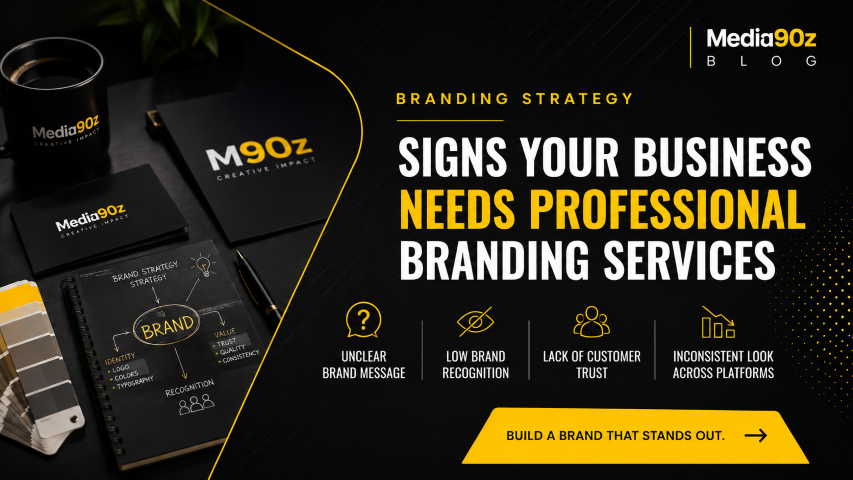
Branding Problems Usually Appear Indirectly
One of the reasons businesses overlook branding issues is because they rarely show up as direct “branding failures.”
Instead, they appear indirectly through symptoms like:
- Weak engagement
- Low conversion rates
- Inconsistent audience perception
- Difficulty standing out from competitors
- Or constant reliance on discounts and aggressive promotion
The business may still operate normally, but the brand itself lacks enough clarity and strength to create lasting impact.
Sign #1: Your Business Looks Different Everywhere
One of the clearest indicators of weak branding is inconsistency.
A website communicates one style. Social media communicates another. Presentations feel disconnected. Messaging changes constantly depending on the platform.
To customers, this creates uncertainty.
Strong brands feel unified. Every touchpoint reinforces the same identity, tone, and positioning.
When that consistency is missing, trust weakens automatically.
Sign #2: Customers Remember the Product but Not the Brand
Some businesses manage to generate sales while remaining forgettable.
Customers may remember what was sold, but not who sold it.
This usually happens when branding focuses only on functionality without creating emotional or visual distinction.
Professional branding helps businesses become recognizable not just usable.
And recognition is what creates long-term market presence.
Sign #3: Your Marketing Feels Harder Than It Should

Weak branding increases marketing friction.
Without strong positioning, businesses constantly need to explain themselves, justify pricing, or work excessively hard to gain attention.
This makes every campaign more expensive and less efficient.
Strong branding simplifies communication because customers already understand what the business represents before the conversation even begins.
Sign #4: Competitors Feel More “Established” Than You
Sometimes competitors are not actually better.
They simply appear more credible.
In competitive industries, perception heavily influences authority. Businesses with stronger branding often look more organized, more experienced, and more trustworthy even when offering similar services.
This perception gap can directly affect customer decisions.
Sign #5: Your Business Has Grown, but the Brand Hasn’t
Many businesses evolve operationally while their branding stays stuck in an earlier stage.
The company improves. Services expand. Quality increases.
But the brand identity still reflects a smaller, older version of the business.
This creates misalignment between reality and perception.
Professional branding helps close that gap so the business externally reflects the level it has internally reached.
Why Professional Branding Matters More in 2026
Modern audiences make decisions faster than ever.
Before reading deeply, before contacting a business, before comparing details, They form impressions almost instantly.
And those impressions are shaped through:
- Visual identity
- Messaging
- Website experience
- Content quality
- Brand consistency
In other words, branding now influences trust before logic even enters the conversation.
Branding Is Not Decoration, It’s Positioning
One of the biggest misunderstandings about branding is assuming it exists only to make a business “look better.”
In reality, branding exists to position the business correctly in the customer’s mind.
A strong brand communicates:
- Who the business is
- What it stands for
- Why it matters
- And why customers should trust it
FAQ
What do professional branding services include?
+
They typically include brand strategy, visual identity, messaging, positioning, and consistency across all customer touchpoints.
Can branding improve sales?
+
Yes. Strong branding increases trust and reduces hesitation during purchasing decisions.
How do I know if my branding is outdated?
+
If your business has evolved but your identity, messaging, or perception no longer reflect your current level, your branding likely needs updating.


Businesses do not outgrow branding.
They grow into needing it more.
Because as competition increases, the brands that succeed are rarely the loudest. They are the clearest, most recognizable, and most trusted.
At Media90z, we help businesses build branding systems that create clarity, strengthen perception, and position brands for long-term growth.